Operate in Cayman
Operate in Cayman
Get on the air in the Cayman Islands — fast. This page covers the essentials for residents and visitors alike.
Quick Reference
| What | Frequency | Offset | Tone | Notes |
|---|---|---|---|---|
| Grand Cayman Repeater (ZF1A) | 146.760 MHz | −0.6 MHz | — | Primary VHF repeater, Grand Cayman |
| Cayman Brac Repeater (ZF1A) | 147.300 MHz | +0.6 MHz | — | Covers Cayman Brac |
| 2 m Calling | 146.520 MHz | — | — | Local simplex calling practice |
| 70 cm Calling (CARS-recommended) | 433.500 MHz | — | — | UHF simplex calling; not 446.000 |
| APRS | 144.390 MHz | — | — | Red Bay iGate active on Grand Cayman |
Detailed band plan: See the Cayman band plan for full frequency allocations. OfReg Spectrum Map: View the official OfReg Spectrum Map for interactive allocation visualisation.
CARS Operating Wallpapers
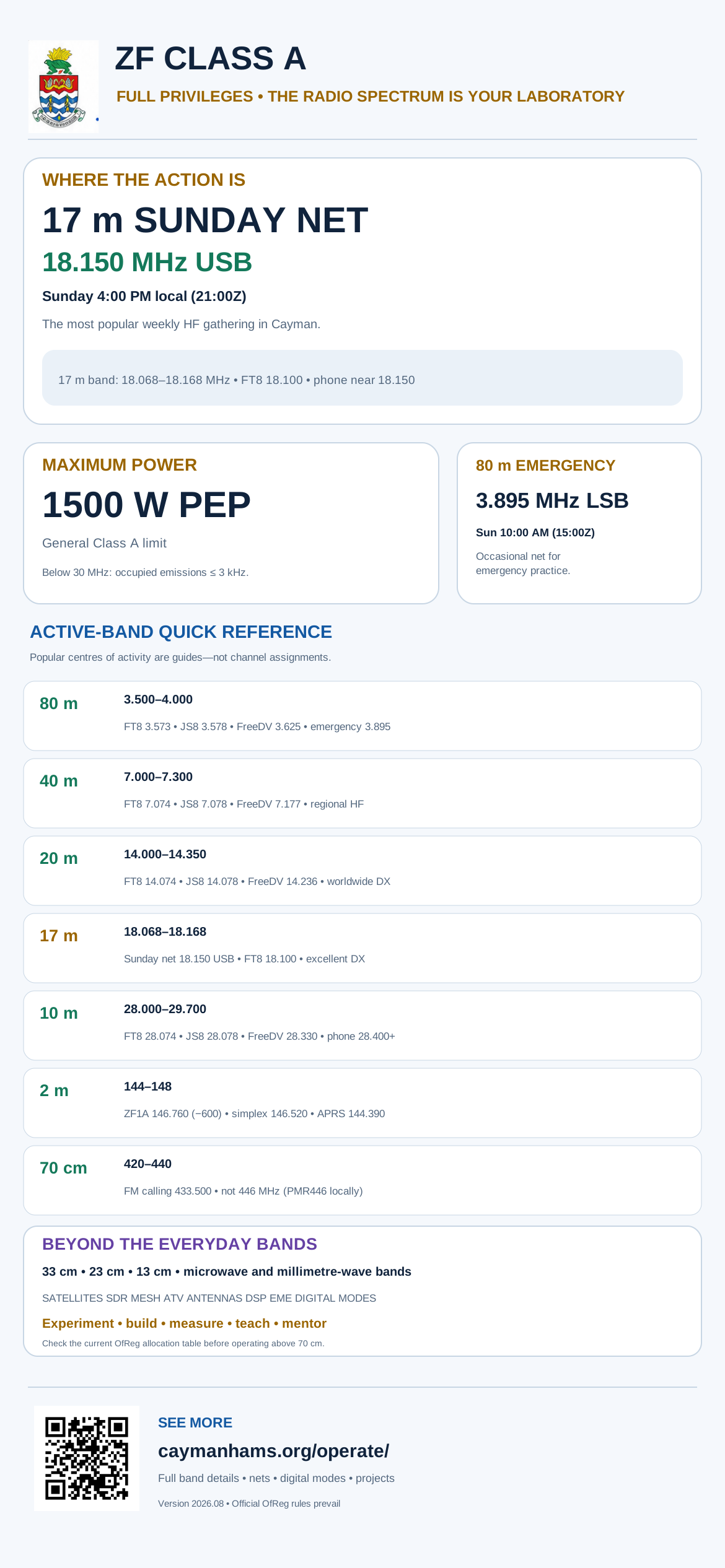
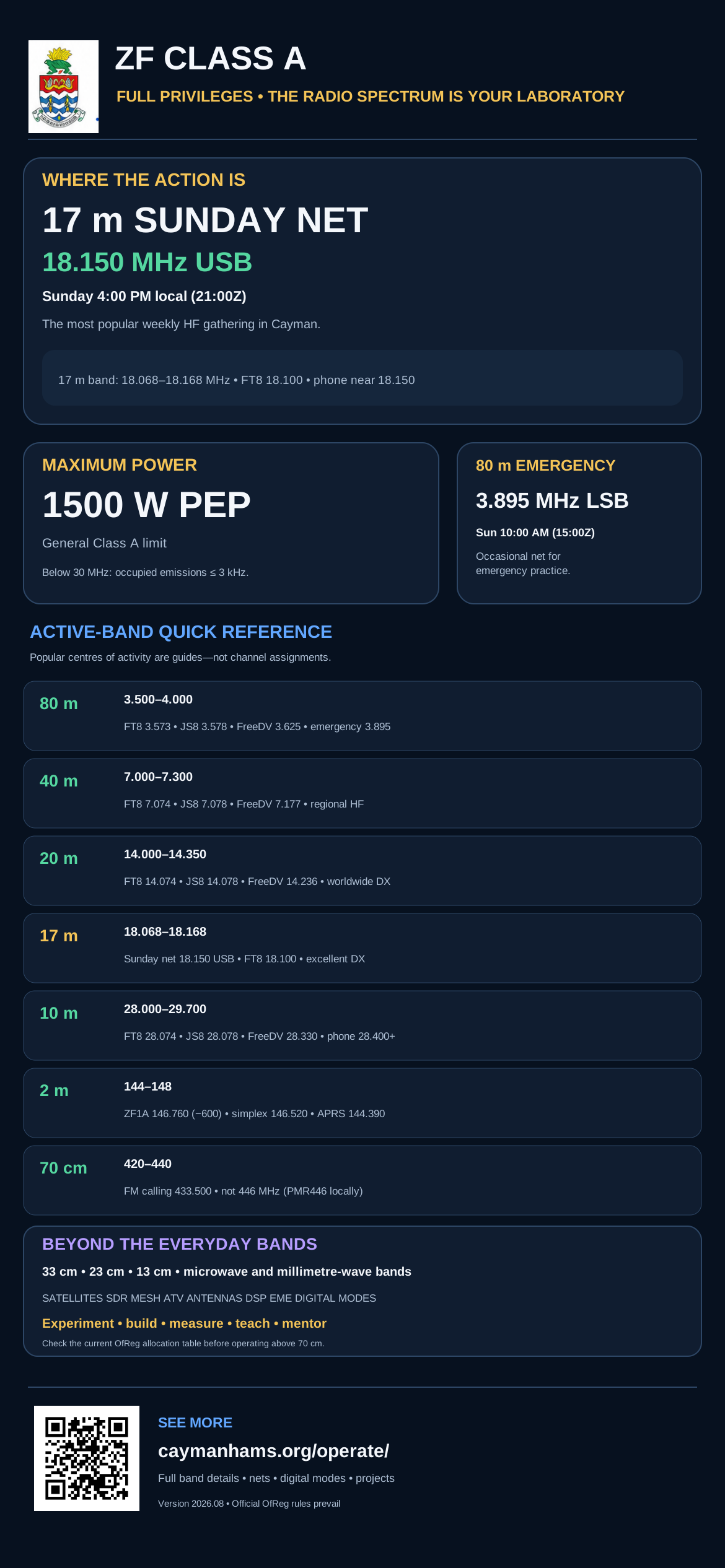
Download a wallpaper for your phone with the Cayman band plan and calling frequencies at a glance. Two versions — one for each licence class.
Class A — Full Spectrum
Full amateur radio privileges: all bands 2200 m through 1.2 cm, up to 1500 W PEP, 60 m at 50 W ERP. Your laboratory is the entire radio spectrum.
| Variant | Preview | Download |
|---|---|---|
| Light | 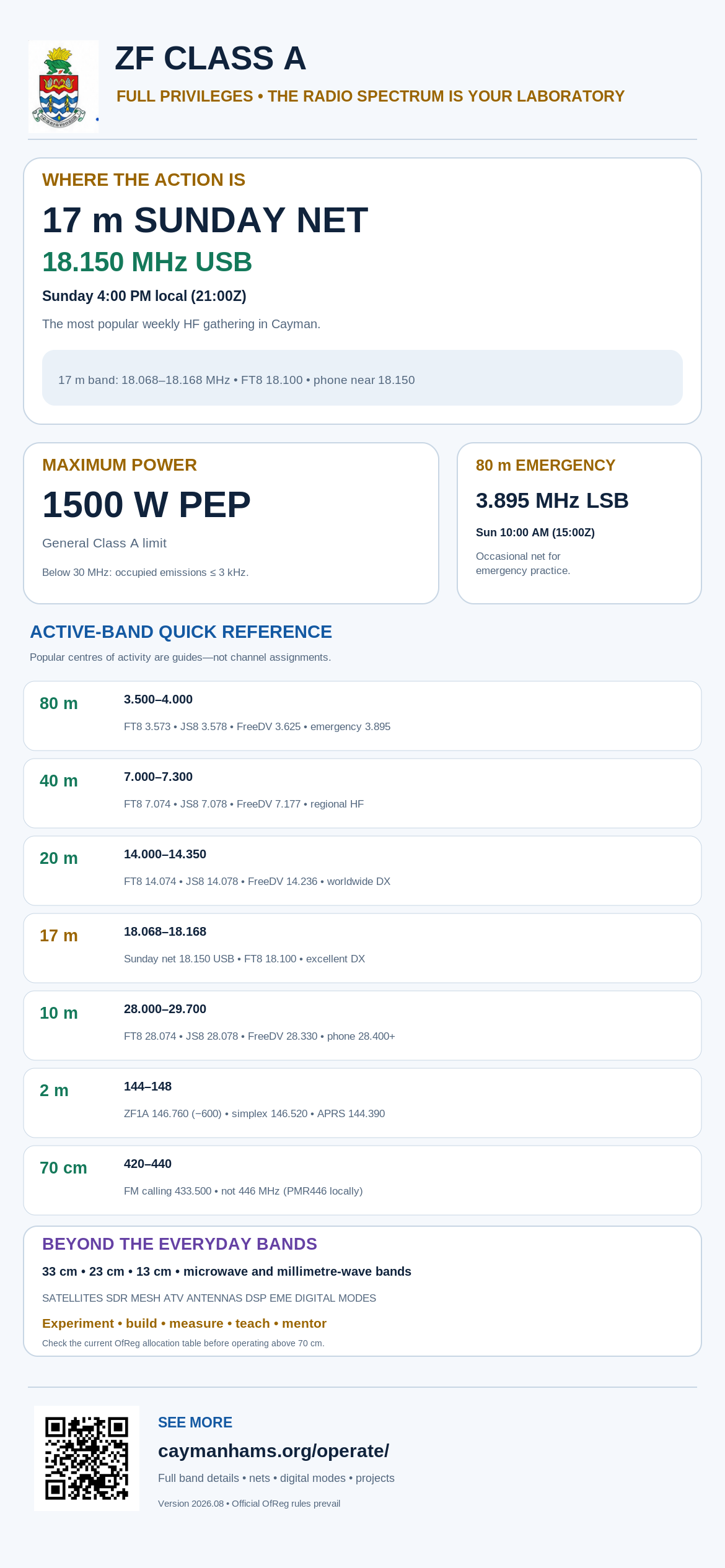 | PNG · SVG · PDF |
| Dark | 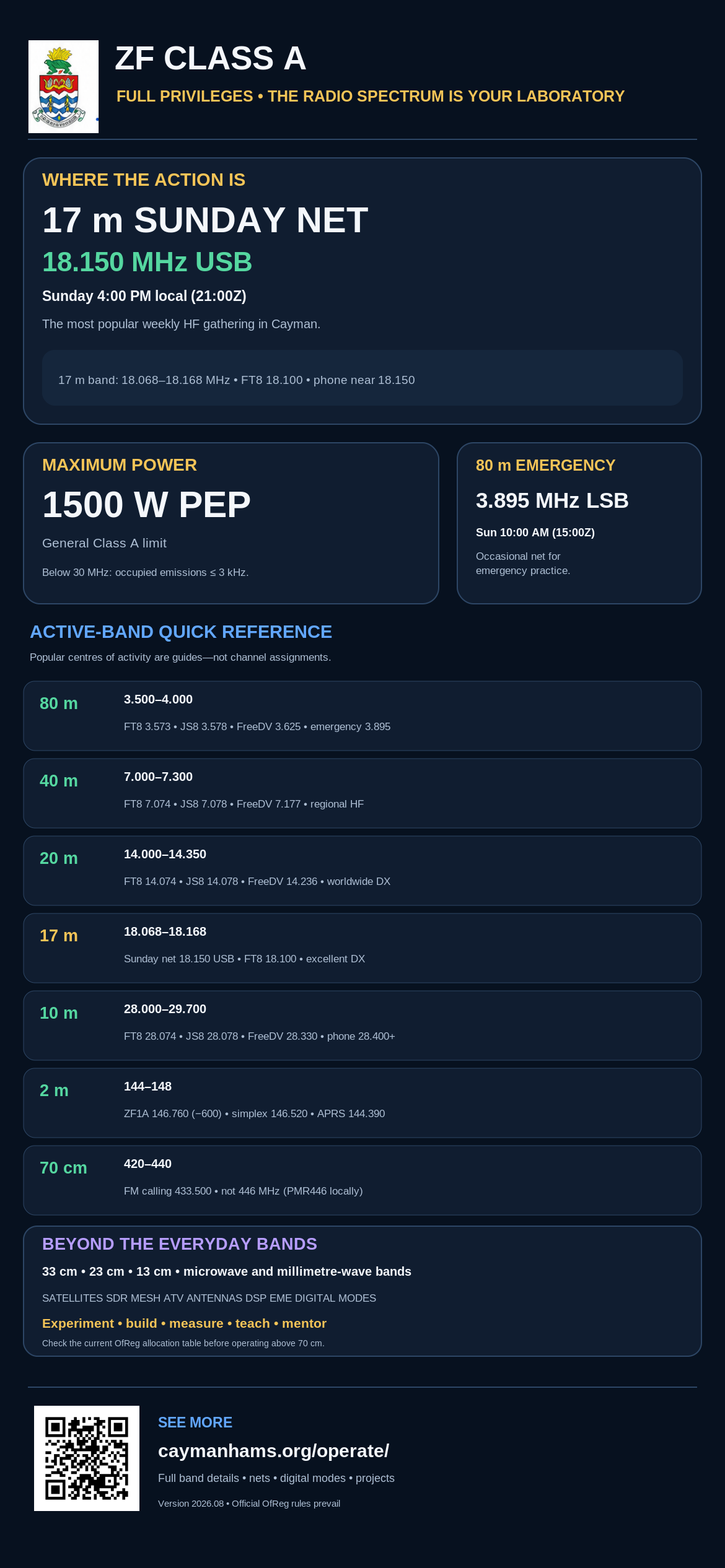 | PNG · SVG · PDF |
Class B — Foundation Licence
VHF/UHF bands plus restricted HF sub-bands: 80 m, 40 m, 15 m, and 10 m at up to 100 W PEP. Full access to 6 m, 2 m, 70 cm, and above.
| Variant | Preview | Download |
|---|---|---|
| Light | 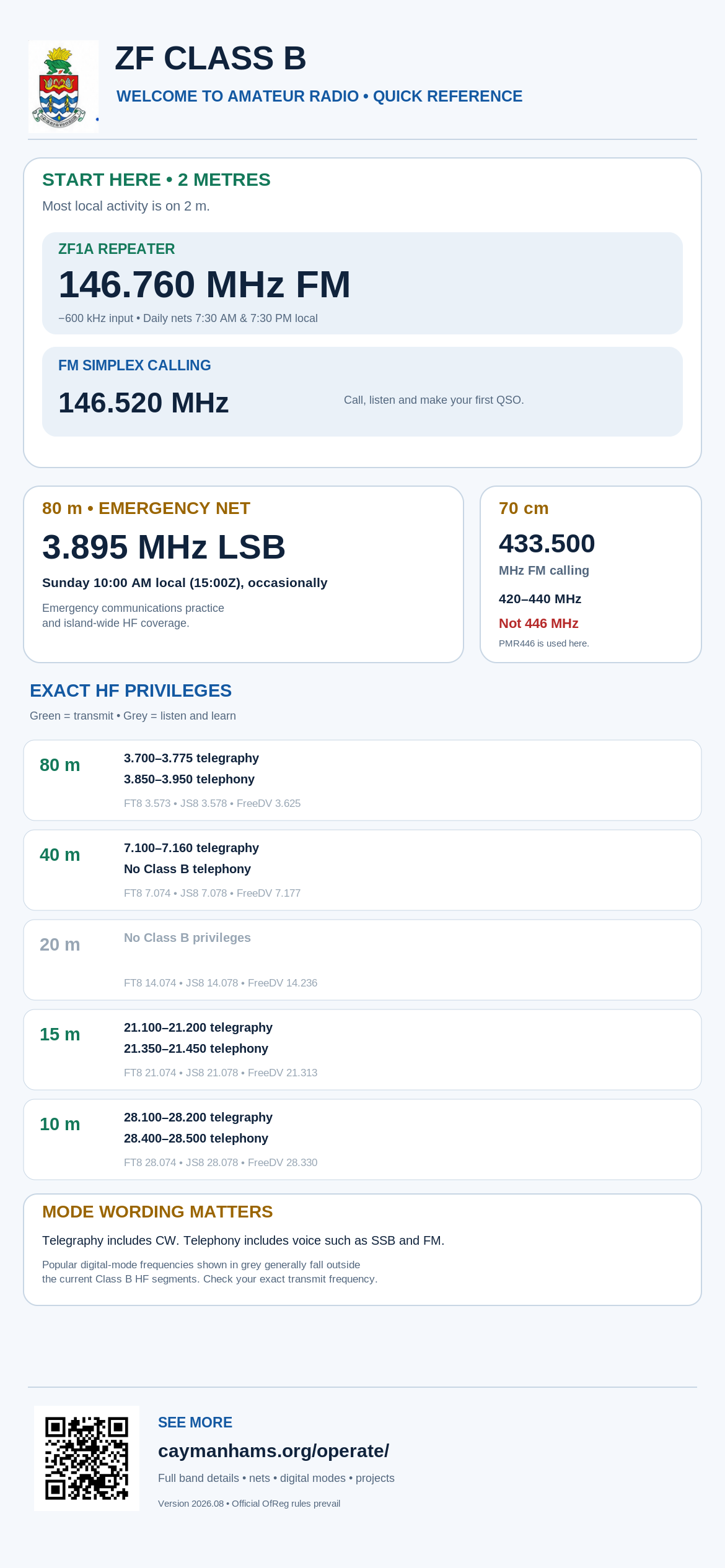 | PNG · SVG · PDF |
| Dark | 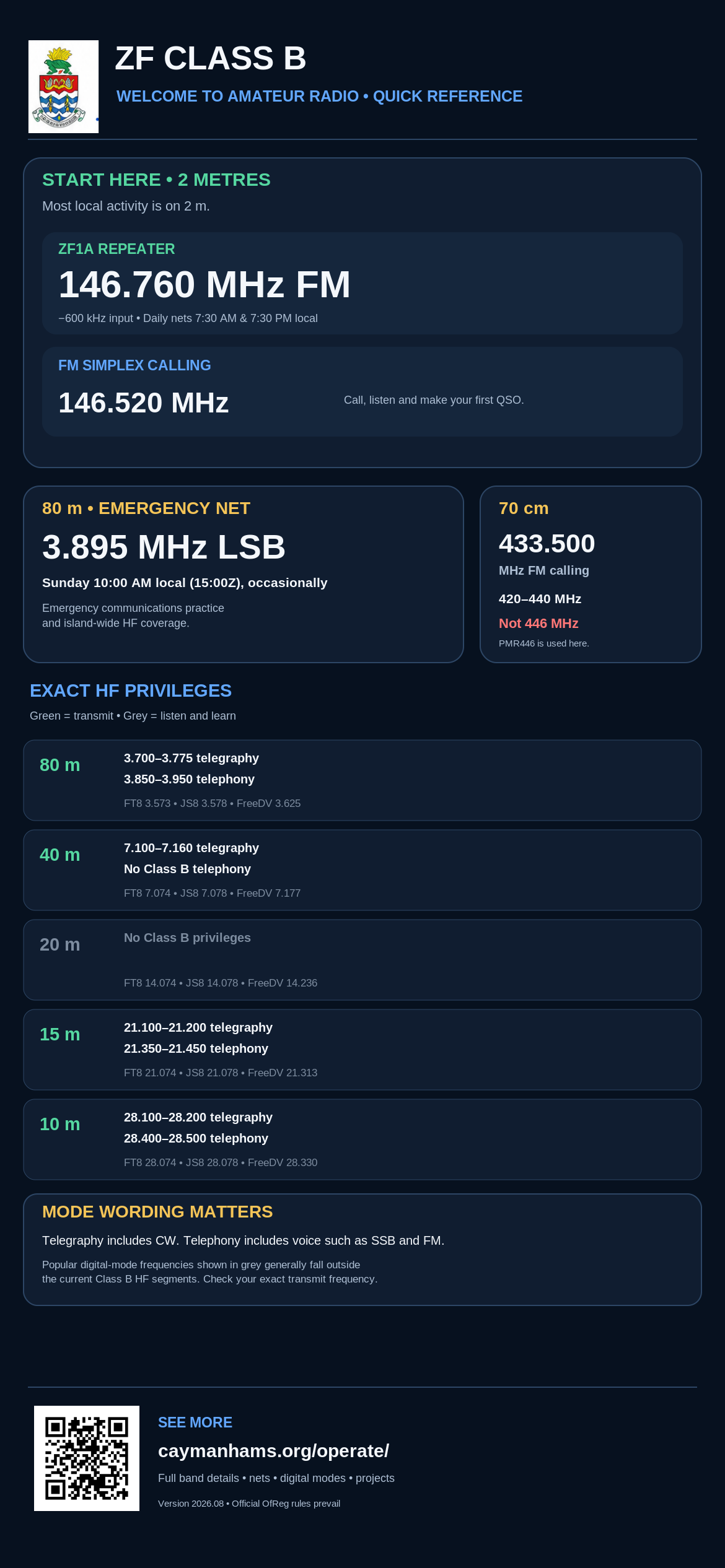 | PNG · SVG · PDF |
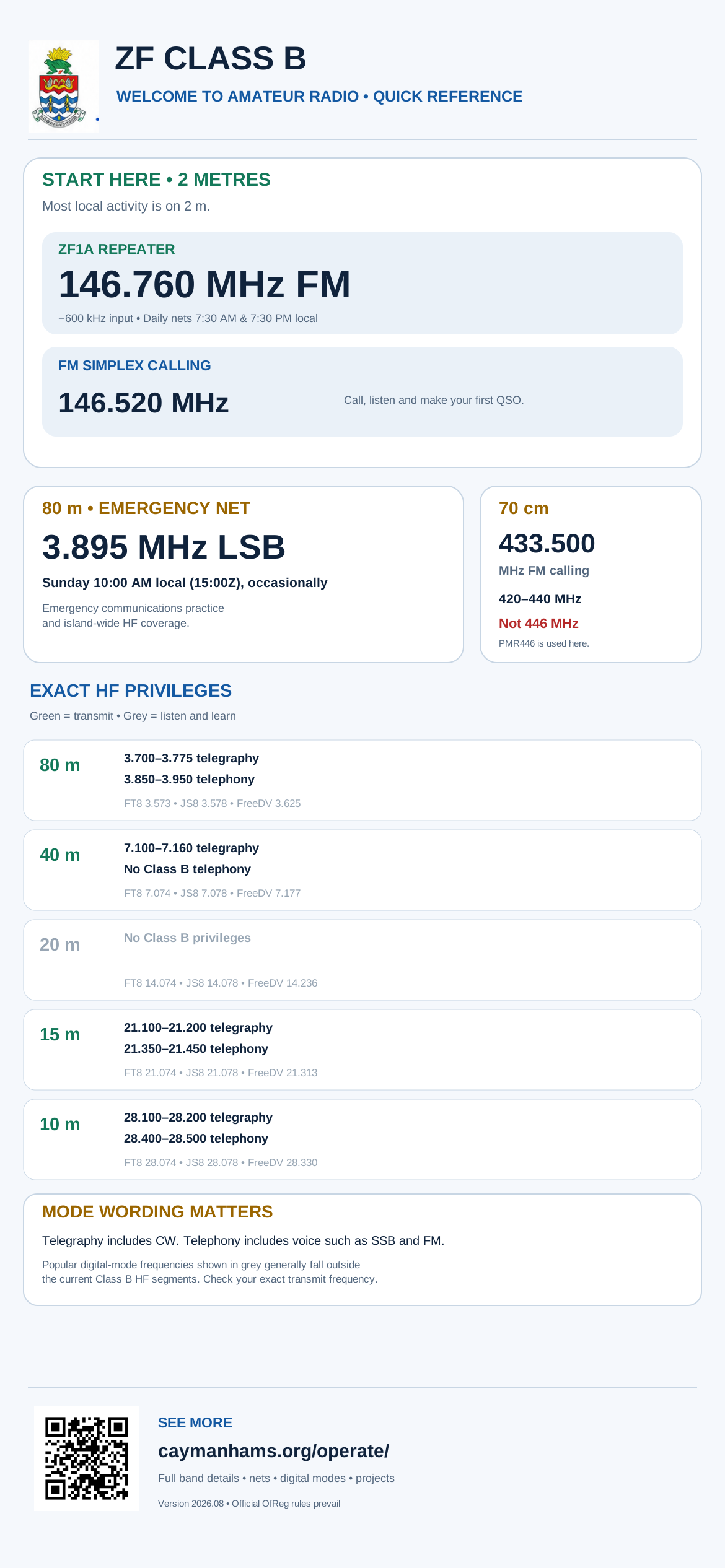
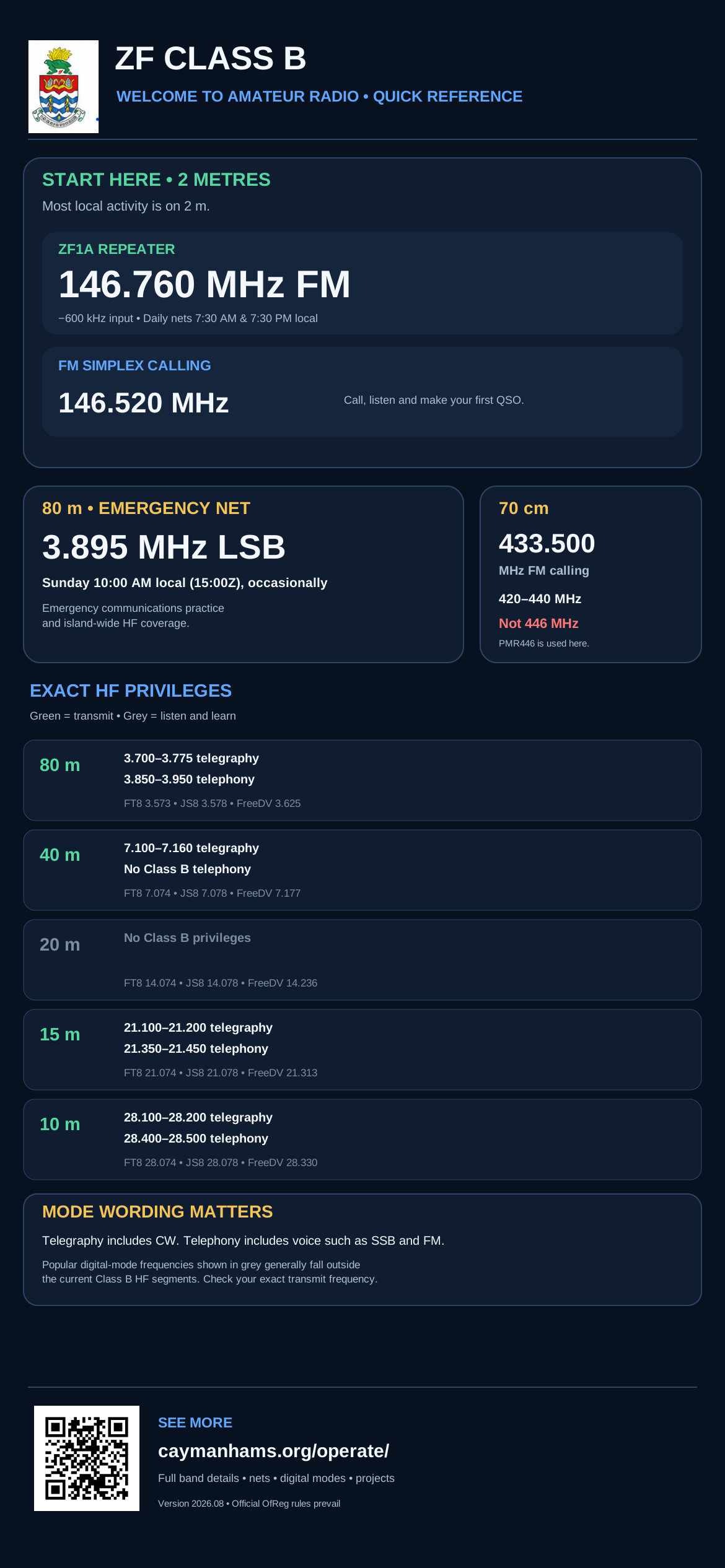
Scan the QR code on the wallpaper to return to this page.
Licence Classes
Class A — Full Spectrum
Class A is the Cayman Islands’ highest amateur licence class. It grants access to the full amateur radio spectrum from 2200 m through 1.2 cm — treat the entire allocation as your laboratory.
Key privileges:
- All amateur bands from 2200 m (135.7 kHz) to 1.2 cm (24 GHz)
- Up to 1500 W PEP on most bands
- 50 W ERP on 60 m channelised (USB only) and continuous secondary 5.3515–5.3665 MHz at 15 W e.i.r.p. — details
- Maximum 3 kHz occupied emission bandwidth below 30 MHz
- All modes: SSB, CW, digital, FM, and experimental
Class B — Foundation Licence
Class B is the entry-level licence, designed for new operators. It provides access to VHF/UHF bands plus restricted HF sub-bands, all at up to 100 W PEP.
Key privileges:
- Full access to 6 m, 2 m, 70 cm, 33 cm, 23 cm, and all higher bands
- Restricted HF sub-bands at up to 100 W PEP:
| Band | Sub-band | Mode |
|---|---|---|
| 80 m | 3.700–3.775 MHz | Telegraphy (CW) |
| 80 m | 3.850–3.950 MHz | Telephony (SSB) |
| 40 m | 7.100–7.160 MHz | Telegraphy (CW) only |
| 15 m | 21.100–21.200 MHz | Telegraphy (CW) |
| 15 m | 21.350–21.450 MHz | Telephony (SSB) |
| 10 m | 28.100–28.200 MHz | Telegraphy (CW) |
| 10 m | 28.400–28.500 MHz | Telephony (SSB) |
What this means: As a Class B operator, you can explore HF on 80 m, 40 m, 15 m, and 10 m within the sub-bands above. You have full access to 6 m and all VHF/UHF/SHF bands — plenty of room to experiment and grow.
Digital Modes
Cayman amateurs actively use digital modes across multiple bands:
| Mode | Common Frequencies | Notes |
|---|---|---|
| FT4 | 28.080, 21.080, 14.080, 7.080, 3.580 MHz | 10 m, 15 m, 20 m, 40 m, 80 m |
| FT8 | 144.174, 50.313, 28.074, 24.915, 21.074, 18.100, 14.074, 10.136, 7.074, 3.573 MHz | 2 m, 6 m, 10 m, 12 m, 15 m, 17 m, 20 m, 30 m, 40 m, 80 m |
| FreeDV | 50.500, 28.600, 21.313, 18.120, 14.236, 7.177, 3.632 MHz | 6 m, 10 m, 15 m, 17 m, 20 m, 40 m, 80 m |
| JS8Call | 28.078, 21.078, 18.104, 14.078, 7.078, 3.578 MHz | 10 m, 15 m, 17 m, 20 m, 40 m, 80 m |
| RTTY | 28.080, 21.080, 14.080, 7.080, 3.590 MHz | 10 m, 15 m, 20 m, 40 m, 80 m |
| APRS | 144.390 MHz | Automatic Packet Reporting System |
Digital mode operation is permitted on any band where the mode is listed in the band plan. Always follow established IARU band-plan sub-band recommendations for digital operation.
Meshtastic — No Licence Required
Meshtastic is an open-source platform for off-grid text messaging and location sharing over LoRa radio. It operates on the 915 MHz ISM band, which is not amateur spectrum — no amateur licence is required.
It’s a great way to get started in radio as it doesn’t require a licence. Great for education of all ages — we have had 10-year-olds build nodes on the island.
See the Meshtastic page for details on the CARS island-wide mesh project and how to host a node.
Why not 446.000 MHz?
Why not 446.000 MHz? In the United States, 446.000 MHz is a familiar 70 cm FM calling frequency. In the Cayman Islands the amateur allocation is 420–440 MHz only; 440–450 MHz is not an amateur allocation, so 446 MHz is outside amateur spectrum. (Separately, OfReg authorises PMR446 in 446.000–446.200 MHz — channel 1 at 446.00625 MHz — which is a further reason not to treat 446 as an amateur calling channel.) Program the CARS-recommended UHF calling frequency 433.500 MHz instead.
Before You Transmit in Cayman
- You must hold a valid amateur radio licence recognised by OfReg.
- Visitors holding a foreign licence should check CEPT reciprocal licensing (T/R 61-01) and callsign format (
ZF/[home call]where applicable). - Amateur operation is only permitted within the frequency bands allocated by OfReg.
- Always identify with your assigned callsign.
Visitor Callsign and Licensing Summary
Under the CEPT reciprocal licensing arrangement (published by CEPT’s Electronic Communications Committee (ECC) as Recommendation T/R 61-01), amateur radio licensees from listed countries who meet that Recommendation’s criteria (typically Class A equivalence) may operate in the Cayman Islands for a period not exceeding 3 months using the callsign ZF/[home call]. Do not append /ZF1 or /ZF to the home callsign.
For stays of over 3 months, or for other visitors whose countries have a reciprocal agreement with the United Kingdom that references the Cayman Islands (including Class B operators from CEPT T/R 61-01 countries), a licence application will need to be made with URCO.
You should:
- Carry your original licence or a verified copy.
- Identify as
ZF/[home call]when operating under CEPT T/R 61-01 (≤3 months, Class A equivalence). - Contact OfReg / URCO licensing (or licensing@ofreg.ky) for longer stays, Class B visitors, or other reciprocal cases.
For visitor journey context, see the Visit page.
Local Repeater Summary
Two active ZF1A repeaters serve the islands:
- Grand Cayman — 146.760 MHz (−0.6 MHz offset). Located on a 150 ft tower at Northward.
- Cayman Brac — 147.300 MHz (+0.6 MHz offset). Located on the Government tower.
Both repeaters are FM only. See the Repeaters page for detailed coverage and operational notes.
APRS in Cayman
144.390 MHz is the established APRS frequency in the Cayman Islands. A receive-only iGate is active at Red Bay on Grand Cayman, providing APRS-IS connectivity. Digipeater coverage is limited to Grand Cayman.
Cayman-Specific Operating Practices
- 2 m simplex calling on 146.520 MHz is the primary local calling practice.
- UHF calling — 433.500 MHz is the CARS-recommended 70 cm FM simplex calling frequency.
- 70 cm ends at 440 MHz — Cayman amateur UHF is 420–440 MHz only; 440–450 MHz (including 446 MHz) is not amateur spectrum. PMR446 occupies 446.000–446.200 MHz as a non-amateur service. Use 433.500 MHz for UHF calling.
- Band plans follow OfReg’s National Frequency Allocation Table. Some familiar overseas channels may fall outside amateur allocations here.
Why Familiar Overseas Channels May Differ Locally
The Cayman Islands is a small jurisdiction with its own spectrum regulation. Frequencies that are standard amateur allocations elsewhere (such as 446.000 MHz in the US) may sit outside Cayman’s amateur edges (70 cm is 420–440 MHz only) or be assigned to other services (e.g. PMR446 at 446.000–446.200 MHz). Always consult the OfReg National Frequency Allocation Table before transmitting on an unfamiliar frequency.
STEM and Education
Amateur radio is a powerful platform for STEM education. CARS welcomes:
- School groups interested in radio, electronics, and propagation
- Scout groups participating in Jamboree on the Air (JOTA)
- New operators studying for their licence examination
- Experimenters exploring antenna design, digital modes, and microwave techniques
Contact CARS to arrange a visit to the club shack or to participate in a net.
POTA and Visitor Operating Locations
The Cayman Islands offer over 40 POTA locations across Grand Cayman, Little Cayman, and Cayman Brac. See the POTA page for park details, access information, and activation tips. Visiting operators can also borrow a free loaner battery from Phil Bodden, ZF1PB.
Programming Downloads
Programming files for common radio models are available on the Downloads page.
Official sources prevail. This guide is provided as a convenience. The OfReg National Frequency Allocation Table and associated regulatory notices are the definitive sources for frequency allocations in the Cayman Islands.
Last reviewed: 2026-09-16